
Last updated: July 2026. This guide is for informational purposes only and does not constitute financial or gambling advice. Gambling involves risk of financial loss. Play responsibly and only on licensed platforms.
Table of Content
- What Is Baccarat and How the Game Works
- Baccarat Rules: How a Round Is Dealt Step by Step
- Types of Baccarat Bets and What They Mean
- Baccarat Online, Live Casino and Demo Modes Compared
- How to Play Baccarat Online for Real Money
- Baccarat Strategy: Practical Approach for Beginners
- Popular Baccarat Game Variations You May See Online
- FAQ About Baccarat Online
Baccarat Online: Rules, Strategy, Demo and Real Money Play
RTP
1.06%
Volatility
Low
Min bet
$5

What Is Baccarat and How the Game Works
Baccarat is a comparing card game. Two hands are dealt each round: one called Player, the other called Banker. Your job? Bet on which hand finishes closer to nine points. Or bet that both hands tie. That is, more or less, the entire decision you make.
Despite the tuxedo reputation, baccarat is structurally one of the simplest games in any casino. Once bets are placed, the dealing and drawing of cards follow fixed, automatic rules. You never touch the cards. You never decide whether to hit or stand. The dealer, or the software, handles everything.
This simplicity is exactly why the baccarat game has thrived online. Whether you access it through a Random Number Generator (RNG) interface or a live-dealer studio streamed in real time, baccarat translates naturally to digital platforms. Fast rounds, a low house edge relative to many other table games, and zero in-hand decisions keep attracting both new and experienced players in 2026.
In its most common form, punto banco, the baccarat table accommodates multiple bettors but only two hands are ever dealt. The game uses six or eight standard 52-card decks loaded into a device called a shoe. Macau casinos generate the vast majority of their table-game revenue from baccarat alone, and online platforms in India and across Asia have followed that trend.

"In punto banco, visitors do not make strategic decisions during play - the draw rules are fully automated." - Ethier & Levin, The Evolution of Baccarat, game-theoretic analysis. arXiv
This guide walks through baccarat rules in detail, compares the different formats available online, and examines strategy and bankroll management through the lens of probability and published research. It is written for readers approaching the game for the first time, though experienced players looking for a structured reference should find it useful too.
The Objective of the Game and the Table Layout
The goal is simple: predict which hand, Player or Banker, will finish with a point total closest to nine. You can also bet that both hands will tie.
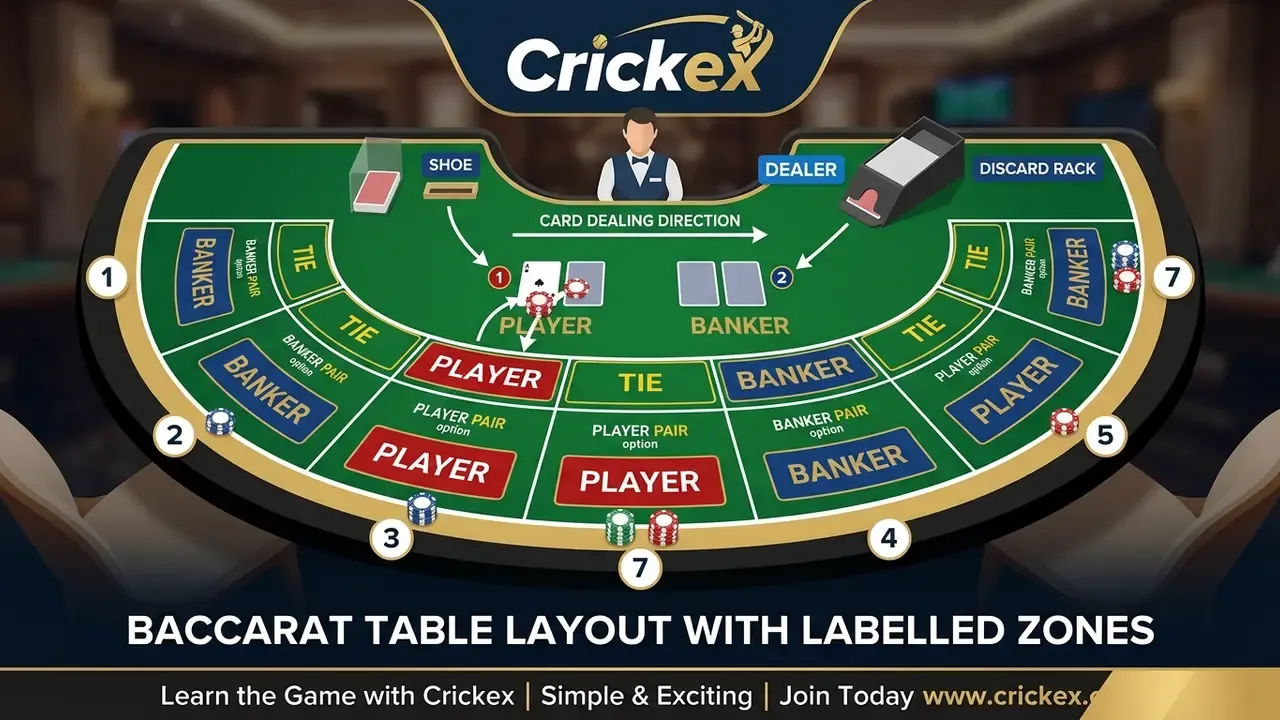
A standard baccarat table has clearly marked betting areas. On one side you see the Player zone, on the other the Banker zone, and between them the Tie area. The dealer sits at the centre, managing the shoe and dealing cards according to fixed rules. Some tables also display side-bet zones for options like Player Pair or Banker Pair.
In online formats, the layout is compressed into a digital interface, but the zones remain the same. You click or tap the area matching your chosen bet, select your chip value, and confirm. The rest is automatic.
One thing that trips up beginners: the "Player" hand does not belong to you. It is just a label. You can bet on either side, or on a tie, regardless of which hand is called what.

Card Values, Points and Natural Hands
Baccarat uses a scoring system built on modular arithmetic. Only the final digit of the sum matters.
| Card | Point Value |
|---|---|
| Ace | 1 |
| 2 through 9 | Face value |
| 10, Jack, Queen, King | 0 |
"Ace counts as 1, cards 2-9 at face value, tens and face cards as 0; the hand total is calculated modulo 10." - Ethier & Levin, game-theoretic analysis of baccara chemin de fer. arXiv
When the sum of card values reaches 10 or more, you drop the tens digit. This is the core counting rule:
- 9 + 7 = 16, so the hand value is 6
- 5 + 8 = 13, so the hand value is 3
- King + 6 = 6 (King counts as 0)
- 4 + 4 = 8, which is a natural
A natural occurs when the first two cards dealt to either hand total exactly 8 or 9. Naturals are the highest possible two-card hands. When one appears, no third card is drawn and the round resolves immediately.
Baccarat Rules: How a Round Is Dealt Step by Step
A single round of baccarat, sometimes called a "coup," follows a strict sequence. The entire procedure is governed by fixed rules, meaning neither the Player nor the Banker side exercises any discretion during the hand.
Here is the sequence:
Betting opens. All participants place wagers on Player win, Banker win, or Tie. Side bets, if available, are placed now too.
Initial deal. The dealer draws four cards from the shoe, alternating between the Player and Banker hands. Each hand receives two face-up cards.
Check for a natural. If either hand totals 8 or 9, the round ends immediately. If both hands are naturals, the higher one wins. If both are the same, it is a tie.
Player third-card rule. If no natural was dealt, the Player hand acts first. Total of 0 through 5? A third card is drawn. Total of 6 or 7? The Player stands.
Banker third-card rule. The Banker's action depends on the Banker's own two-card total and, if the Player drew a third card, on the value of that specific card. A detailed table appears below.
Comparison and payout. Final totals are compared. The hand closest to 9 wins. Winning Player bets pay 1:1. Winning Banker bets pay 1:1 minus a 5% commission (effectively 0.95:1). A Tie bet typically pays 8:1. All losing bets are collected.
This entire sequence is automatic once bets are placed. In punto banco, the version played in virtually all online and most land-based casinos, neither the player nor the house makes any optional decisions about drawing cards.
"If either side holds a natural (8 or 9 points), the round concludes immediately, without drawing a third card." - Washington State Gambling Commission, Progressive Baccarat Rules (2023).
First Two Cards and When a Natural Win Ends the Hand
After the initial deal, the dealer checks both hands for naturals. The logic is straightforward:
- One hand has a natural, the other does not: The natural wins. Bets are settled.
- Both hands have naturals: The higher natural wins. A natural 9 beats a natural 8. If both are the same, it is a tie.
- Neither hand has a natural: The round continues to the third-card drawing phase.
This automatic resolution is one reason baccarat rounds move quickly, particularly in online formats where dealing is instantaneous. In a live-dealer setting, the dealer simply reveals the cards and announces whether a natural has ended the hand.
The natural rule is absolute. It overrides all third-card drawing conditions. No matter what the other hand shows, if one side holds 8 or 9, the round stops.

Third Card Rules for Player and Banker
When neither hand holds a natural, the third-card rules determine whether additional cards are drawn. These rules are entirely fixed. In punto banco, the Player must draw on a total of 5 or below, and the Banker follows a fixed decision table based on the Player's third card.
"In punto banco the Player must draw on 5 or below; the Banker follows a fixed decision table that depends on the Player's third card." - Washington State Gambling Commission, Progressive Baccarat Rules (2023).
Player third-card rule:
| Player's Two-Card Total | Action |
|---|---|
| 0 through 5 | Draw a third card |
| 6 or 7 | Stand |
| 8 or 9 | Natural, no draw |
Banker third-card rule (when Player draws):
If the Player stood on 6 or 7, the Banker follows a simpler rule: draw on 0 through 5, stand on 6 or 7. However, if the Player drew a third card, the Banker's action depends on both the Banker's own total and the specific value of the Player's third card:
| Banker's Total | Player's Third Card: 0 | 1 | 2 | 3 | 4 | 5 | 6 | 7 | 8 | 9 |
|---|---|---|---|---|---|---|---|---|---|---|
| 7 | S | S | S | S | S | S | S | S | S | S |
| 6 | S | S | S | S | S | S | D | D | S | S |
| 5 | S | S | S | S | D | D | D | D | S | S |
| 4 | S | S | D | D | D | D | D | D | S | S |
| 3 | D | D | D | D | D | D | D | D | S | D |
| 2 | D | D | D | D | D | D | D | D | D | D |
| 1 | D | D | D | D | D | D | D | D | D | D |
| 0 | D | D | D | D | D | D | D | D | D | D |
D = Draw a third card. S = Stand.
This table is the most complex rule in baccarat, but here is the thing: you do not need to memorize it. The dealer or software executes it automatically. Its complexity is actually the reason the Banker hand has a slight statistical edge. The Banker acts second and benefits from positional information about the Player's third card.
Important clarification: The Banker's conditional draw rules apply only when the Player draws a third card. If the Player stands on 6 or 7, the Banker simply draws on 0 through 5 and stands on 6 or 7. Several beginner guides skip this distinction, which creates unnecessary confusion.
[Image: Step-by-step flowchart of a single baccarat round showing bet placement, initial deal, natural check, third-card decision, and outcome. Alt text: "baccarat round flowchart from bet to result"]
Types of Baccarat Bets and What They Mean
Baccarat offers three core bets. Understanding their payouts and the mathematical reasoning behind them matters before placing any wager.
Banker, Player and Tie Bets
Player bet. A wager that the Player hand will finish with a higher total than the Banker hand. Winning Player bets pay 1:1 (even money) with no commission.
Banker bet. A wager that the Banker hand will finish with a higher total. Winning Banker bets pay 0.95:1, which is even money minus a 5% commission. The commission exists because the Banker hand wins slightly more often due to its positional advantage.
"Banker wins pay 19 to 20, which is equivalent to even money less a 5% commission." - Wizard of Odds, Eight-Deck Baccarat Analysis.
Tie bet. A wager that both hands will finish with the same total. The standard payout is 8:1, though some tables offer 9:1. Despite its attractive payout ratio, the Tie bet carries a dramatically higher house edge and is generally regarded as the weakest main bet in baccarat.
How do these payouts connect to house edge? The house edge on the Banker bet is approximately 1.06% (with the 5% commission), while the Player bet carries a house edge of approximately 1.24%. The Tie bet's house edge is roughly 14.36% at the standard 8:1 payout.
"The house edge on the Banker bet is 1.06% in 8-deck baccarat; the Player bet is 1.24%; the Tie bet at 8:1 is 14.36%." - Ethier & Levin, Punto Banco House Edge Calculations. arXiv
For practical purposes, this means that for every ₹10,000 wagered on the Banker over a sufficiently long sample, a player can expect to lose approximately ₹106. On the Tie, that expected loss rises to approximately ₹1,436. The difference is significant.
Side Bets and When They Appear in Online Games
Many online baccarat games offer additional wagering options beyond the three core bets. These side bets add variety but consistently carry higher house edges.
| Side Bet | Payout | Approximate House Edge |
|---|---|---|
| Player Pair | 11:1 | ~10.36% |
| Banker Pair | 11:1 | ~10.36% |
| Either Pair | 5:1 | ~10.36% |
| Perfect Pair | 25:1 | ~13.03% |
| Dragon Bonus | Up to 30:1 | ~9.37% to 9.42% |
- Player/Banker Pair:Wins if the first two cards dealt to the respective hand share the same rank (two 7s, for example).
- Perfect Pair:Wins if the first two cards match in both rank and suit.
- Dragon Bonus:Pays based on the margin of victory. A natural win or a win by 4+ points triggers escalating payouts up to 30:1.

Side bets are popular on online tables for their entertainment value. But the house edges, ranging from roughly 9% to over 13%, are substantially higher than those on the core Player and Banker bets. Experienced players typically treat side bets as occasional fun rather than a primary wagering approach.
Worth noting: not every baccarat table offers the same side bets. Live baccarat tables from providers like Evolution or Pragmatic Play may include options that RNG tables do not. Always check what is available before you sit down.
Baccarat Online, Live Casino and Demo Modes Compared
Online baccarat is available in several formats, and picking the right one depends on what you are looking for: practice, speed, or realism.
When Baccarat Demo Is the Best Starting Point
Demo mode, sometimes called "practice" or "free play," lets you experience baccarat without risking real money. The game mechanics are identical to the real-money version, but wagers use virtual credits.
Why start here? A few reasons:
- Zero financial risk. You can place bets, see results, and observe the third-card rules in action without spending anything. Mistakes cost nothing.
- Understanding game flow. Baccarat demo replicates the actual pace of play, including dealing procedures, result announcements, and payout calculations. This builds comfort with the interface before the stakes are real.
- Internalizing the third-card rules. Repeated exposure to which hands draw and which stand helps beginners absorb the rules naturally, rather than memorizing a chart in isolation. After about 50 to 100 hands, most players can predict the outcome before the software acts.
- Familiarizing with the interface. Every online baccarat table has buttons for bet placement, chip selection, and result history. Demo play is the safest way to learn where everything is and avoid misclicks when real money is on the line.
Most licensed online casinos offer demo or free-play versions of their RNG baccarat games without requiring a deposit. Live-dealer games typically require a real-money account, which is one reason beginners often start with RNG demo mode before progressing.
How Live Dealer Baccarat Differs from Regular Online Baccarat
RNG baccarat is fully software-driven. Card outcomes are determined by a certified random number generator. No physical shoe, no human dealer, no waiting. Rounds can finish in 10 to 15 seconds, and minimum bets are often very low, sometimes as little as ₹10 to ₹100.
Live dealer baccarat is streamed from a professional studio. A real human dealer shuffles, deals, and reveals physical cards on camera. Optical Character Recognition (OCR) technology converts the visible card values into digital game data in real time. Multiple camera angles let you watch the shoe, the dealing process, and even the card squeeze in certain formats.
Live baccarat tables typically have higher minimum bets (often ₹500 to ₹2,000 or more), and rounds take longer due to the physical dealing process and betting countdown timer. However, many players prefer live baccarat for its transparency and realistic atmosphere. There is something about watching actual cards being turned that an RNG screen simply cannot replicate.

"Live-dealer games generally demonstrate lower volatility and a somewhat lower house edge compared to RNG equivalents." - Ball State University eSpace, Comparison of Live Dealer vs. RNG Casino Games.
| Feature | Demo (Free Play) | RNG (Real Money) | Live Dealer |
|---|---|---|---|
| Cost | Free (virtual credits) | Real money | Real money |
| Speed per round | Player-controlled | ~10 to 15 seconds | ~27 to 48 seconds |
| Minimum bet | None | Often ₹10 to ₹100 | Often ₹500 to ₹2,000 |
| Realism | Low (simulated) | Medium (software) | High (real cards, real dealer) |
| Betting timer | Usually none | Brief or none | Fixed countdown (10 to 20 sec) |
| Learning value | Excellent | Moderate | Lower for pure beginners |
| Available 24/7 | Yes | Yes | Yes (most studios) |
How to Play Baccarat Online for Real Money
Important: Gambling involves risk of financial loss. The information below is for general educational purposes and does not replace professional advice. Play responsibly and only on licensed platforms. Never treat baccarat as a source of income.
Transitioning from demo to real-money baccarat involves a few practical steps. None of them are complicated, but skipping any of them can create problems later.
Choosing a Baccarat Casino and Table
Not all baccarat casinos or tables are created equal. Selecting the right environment matters for both your experience and your safety.
Five criteria for evaluating an online baccarat casino in 2026:
- Verifiable license. The license number and regulator should match the public registry. A missing or unverifiable license is an immediate red flag.
- Independent game audits. Certifications from eCOGRA, iTech Labs, or BMM Testlabs confirm that the RNG produces fair outcomes and that live-dealer baccarat games are not manipulated.
- Transparent payout terms. The casino should clearly state withdrawal processing times, limits, and any fees. For Indian players, check whether INR deposits via UPI, NetBanking, or popular e-wallets are supported.
- Responsible gambling tools. Deposit limits, loss limits, session timers, and self-exclusion options should be easy to find and use.
- Recognized software providers. Baccarat games from established providers like Evolution, Pragmatic Play, or Ezugi carry their own layer of regulatory oversight and testing.
Table selection tips:
- Check the commission. Standard tables charge 5% on Banker wins. No-commission tables use the Banker-6 half-pay rule instead. Understand which applies before you bet.
- Match table limits to your bankroll. If your session bankroll is ₹5,000, a table with a ₹2,000 minimum bet gives you only two or three hands before you are out. Lower-limit tables extend your playing time and reduce variance per hand.
- Review available side bets. Side bets are optional but can be tempting. Know the house edge on each one before adding them to your wagers.

"The strongest predictors of problem gambling were frequency of participation, expenditure, and number of gambling forms - not demographic factors." - SEIGMA six-year longitudinal study of gambling and problem gambling.
From Demo Play to First Real Money Session
For players who have practiced in baccarat demo mode and feel ready to try real-money play, a measured approach reduces common mistakes.
Step 1: Register and verify your account. Create an account using accurate personal information. Most regulated casinos require Know Your Customer (KYC) verification, typically a photo ID and proof of address, before processing withdrawals. Completing this early avoids delays later.
Step 2: Set deposit and session limits. Before depositing, use the responsible gambling tools provided by the casino to set limits on deposits, losses, and session duration.
Step 3: Deposit funds. Choose a payment method and deposit an amount you can afford to lose entirely. For Indian players, UPI and popular e-wallets often process fastest. Cryptocurrency options are also available on some platforms.
Step 4: Start at the lowest available stakes. Choose a baccarat table with a minimum bet of ₹10 to ₹100. The goal of your first session is to gain comfort with the real-money interface, not to chase a big win.
Step 5: Stick to Player or Banker bets only. Avoid the Tie bet and side bets until you have a clear understanding of their house edges and you are comfortable with the core game.
Step 6: Review your session afterward. After your first session, take note of how many hands you played, how long the session lasted, and how much you won or lost. This self-review builds awareness and helps calibrate future sessions.
Progression path:

- Demo mode:Play until you can predict, without checking, when a third card will be drawn. This typically takes 50 to 100 hands.
- Micro-stakes RNG:Play at the lowest available real-money stakes for several sessions. Focus on bet discipline, not on winning.
- Live dealer:Once you are comfortable with the pace of real-money play and have internalized bankroll limits, live dealer baccarat at licensed casinos offers a more immersive experience with higher minimum bets and a realistic casino atmosphere.

Responsible play reminder: Real money baccarat involves real financial risk. Set a budget before every session. If you reach your loss limit, stop. No round of baccarat is worth chasing. If gambling stops being entertainment, contact a local helpline or visit BeGambleAware.org.
Baccarat Strategy: Practical Approach for Beginners
Disclaimer: No strategy guarantees a win in a game with a negative expected value. The information below is for educational purposes only.
Baccarat is a game of chance with fixed rules and no player decisions during the hand. Unlike blackjack or poker, there is no way to influence the outcome through skillful play. Strategy in baccarat is therefore limited to bet selection and bankroll management, not to card-play decisions.
Because the draw rules are automatic, baccarat strategy reduces to three questions:
- Which bet should I place? The Banker bet has the lowest house edge (1.06%), followed by the Player bet (1.24%). The Tie bet (14.36%) is mathematically the worst option.
- How much should I bet per hand? This is a bankroll management question, not a game-strategy question.
- When should I stop? Setting win and loss limits before a session begins is the most effective "strategic" tool available.
There is no way to predict which hand will win in an individual round. Cards are dealt from a freshly shuffled shoe or generated by a certified RNG, and each round is independent or nearly independent of previous rounds. Pattern-tracking, following streaks, "choppy shoes," or other perceived trends, does not provide a statistical edge.

Why Many Players Prefer the Banker Bet
The Banker bet's mathematical advantage over the Player bet is small but real. In an eight-deck baccarat game, the Banker hand wins approximately 45.86% of all rounds (including ties), while the Player hand wins approximately 44.62%, and ties occur about 9.52% of the time.
When ties are excluded and only decisive outcomes are counted:
| Outcome | Probability (excluding ties) |
|---|---|
| Banker wins | ~50.68% |
| Player wins | ~49.32% |
In every 100 decisive hands, the Banker wins roughly 51 and the Player wins roughly 49. The difference is small but consistent, and it arises from the Banker's positional advantage: the Banker draws or stands after the Player, using additional information.
The 5% commission on winning Banker bets is the casino's way of pricing this advantage. Even after the commission, the Banker bet's house edge (1.06%) remains lower than the Player bet's (1.24%).
However, and this is important, this does not mean the Banker bet is a path to profit. Over a large number of hands, the house edge ensures a net loss for the player. The Banker bet simply minimizes the rate of that expected loss compared to the alternatives.

"Even if the win probability on the Banker bet were improved to 50% through card counting, the best long-term result would be to break even." - Markov chain / gambler's ruin analysis of baccarat. Academia.edu
Bankroll Control and Simple Betting Discipline
The concept of "gambler's ruin," the mathematical inevitability that a player with a finite bankroll will eventually lose everything to a house with an infinite bankroll, applies directly to baccarat. No betting system overcomes this fundamental asymmetry.
Practical bankroll management does not change the expected outcome of any individual bet. What it does is control the pace and magnitude of potential losses, giving you a structured approach to a recreational activity.
Flat betting. This means wagering the same amount on every hand, regardless of previous outcomes. It is the simplest and most conservative approach. A common guideline is to set each bet at 1 to 5% of your session bankroll, ensuring that a losing streak does not exhaust your funds in a few hands.
Stop-loss limit. A predetermined maximum amount you are willing to lose in a single session. When that limit is reached, you stop playing. No exceptions. Setting a stop-loss at 5 to 10% of your total bankroll (not just your session bankroll) is a common recommendation.
Session time limits. Time limits complement monetary limits. Baccarat rounds are fast, especially in online RNG or Speed Baccarat formats, and it is easy to play far more hands than intended. Setting a timer or using the casino's session-limit tool is a simple safeguard.
Common betting systems and why they do not change the math:
Many baccarat guides present systems like Martingale, Paroli, or Fibonacci as "strategies." It is important to understand that no betting system changes the house edge or the expected value of any wager. These systems alter the distribution of wins and losses across a session, but they do not make the game profitable over time.
- Martingale involves doubling your bet after every loss. A single win recovers all previous losses plus a profit equal to the original bet. The catch? After six consecutive losses starting at ₹500, your seventh bet would need to be ₹32,000, and most tables have a maximum bet limit that prevents this recovery. The Martingale creates a high probability of small wins and a low probability of catastrophic losses.
- Paroli involves doubling your bet after each win, with a reset after three consecutive wins or any loss. It limits your exposure but does not change the house edge.
- Fibonacci uses the mathematical sequence (1, 1, 2, 3, 5, 8, 13, 21...) to determine bet sizes. After a loss, you move forward in the sequence. After a win, you step back two positions. Like Martingale, it can lead to rapidly escalating bets during losing streaks, though the escalation is slower.

"Martingale's apparent progress is blocked by finite bankroll and table limits; it is an illusion." - Peter A. Griffin, The Theory of Blackjack (applicable to all negative-expectation games).
All progressive betting systems share the same fundamental limitation: they rearrange the timing of wins and losses but do not alter the mathematical expectation. In a game with a negative expected value, which baccarat is for the player on every bet, no staking plan can produce a long-term profit.
Fact check: the "guaranteed baccarat strategy" myth. There is no guaranteed winning strategy in baccarat. Any source claiming otherwise is misleading you. Strategy in baccarat helps you manage decisions and money. It does not guarantee wins. The house edge is a permanent mathematical feature of the game, not a problem that clever betting can solve.
Popular Baccarat Game Variations You May See Online
Baccarat exists in several formats. The standard version played in virtually all online casinos is punto banco, where all decisions are automatic. But you will encounter other variations too, and knowing the differences helps you pick the right baccarat game for your preferences.
Standard, Live and Faster-Play Baccarat Formats
Punto banco (standard baccarat). This is the version described throughout this guide. Six or eight standard 52-card decks, all card-drawing decisions fixed by the tableau. Players bet only on the outcome. This is what most casino baccarat tables offer, both RNG and live.
Speed Baccarat. A live-dealer format where dealing pace is increased. Where a standard live baccarat round typically lasts about 48 seconds, Speed Baccarat completes a round in approximately 27 seconds. Cards are dealt face-up immediately, and the betting window is shortened to roughly 10 to 12 seconds. The rules are identical to standard punto banco. Only the tempo changes.
Lightning Baccarat. Developed by Evolution, this variant adds RNG-generated multiplier cards to each round. Between one and five cards from a virtual 52-card deck are randomly selected as "Lightning Cards," each carrying a multiplier of 2x, 3x, 4x, 5x, or 8x. A 20% Lightning Fee is added to the total bet to fund these multiplied payouts. If a winning hand contains one or more matching Lightning Cards, the multipliers apply to the winnings.
Dragon Tiger. Often described as a simplified, two-card version of baccarat. Two cards are dealt, one to the Dragon position and one to the Tiger, and the higher card wins. The Tie bet in Dragon Tiger typically pays 11:1, with a Suited Tie paying 50:1.
Chemin de fer. In this older French version, players take turns acting as the Banker and can choose whether to draw a third card. It involves more player interaction and some optional decision-making. Chemin de fer is rarely offered online.
Baccarat banque. Similar to chemin de fer, but the Banker role is fixed for the duration of the shoe rather than rotating. Even rarer in online settings.

No Commission and Other Table-Specific Rule Changes
No-commission baccarat removes the standard 5% commission on winning Banker bets. To compensate, the casino adjusts the payout for a specific outcome: when the Banker wins with a total of exactly 6, the payout is reduced to 0.5:1 (half of even money) instead of the usual 1:1.
All other Banker wins pay full even money. The mathematical effect is that the casino recovers its edge through the reduced Banker-6 payout rather than through a flat commission. Some tables also offer a "Super 6" side bet, which pays 15:1 if the Banker wins with 6, though this side bet carries its own separate house edge.
No-commission formats have become widely available across both live-dealer studios and RNG platforms. They appeal to players who prefer simpler payout calculations: you either win even money or receive half-pay on Banker-6, with no running commission to track.
However, the overall house edge on the Banker bet in no-commission baccarat is slightly higher than in the standard commission version, typically around 1.46% versus 1.06%. That difference might seem small, but over hundreds of hands it adds up. Know which version you are playing before you sit down.
FAQ About Baccarat Online
Is Baccarat Easier to Learn Than Many Other Casino Games?
Baccarat is widely considered simpler than most table games because the player makes no decisions during the hand. In blackjack, you must decide whether to hit, stand, double, split, or surrender on every hand, and optimal play requires memorizing a basic strategy chart. In poker, you must evaluate hand strength, read opponents, and manage complex betting rounds. In baccarat, you simply choose Player, Banker, or Tie before the deal, and the rules handle everything else. This makes the learning curve substantially shorter, though it also means you have no way to improve your odds through skill.
Should You Start with Demo, Standard Online or Live Dealer Baccarat?
It depends on your goal. If you are learning the rules and want zero risk, baccarat demo mode is the clear starting point. You can play as many hands as you need without spending anything. If you already understand the basics and want faster rounds at low stakes, standard online (RNG) baccarat is a good next step. And if you want the most realistic experience with a real dealer, physical cards, and a studio atmosphere, live dealer baccarat is the format to try, though it comes with higher minimum bets and a fixed betting timer.
A reasonable progression: start with demo, move to micro-stakes RNG once you can predict third-card draws without checking, and then try live baccarat at a licensed casino when you are comfortable with real-money play and have set your limits.
Can I Consistently Win at Baccarat with a Strategy?
No. Baccarat is a negative-expectation game for the player on every available bet. Betting systems like Martingale, Paroli, or Fibonacci change the distribution of short-term outcomes but do not alter the house edge. Over a sufficient number of hands, the house advantage will assert itself. The best a player can do is minimize losses by choosing the Banker bet and practicing disciplined bankroll management.
What Is the Difference Between Standard and No-Commission Baccarat?
In standard baccarat, winning Banker bets pay even money minus a 5% commission. In no-commission baccarat, there is no commission on Banker wins, except when the Banker wins with a total of exactly 6, in which case the payout is halved to 0.5:1. This rule change slightly increases the overall house edge on the Banker bet (from ~1.06% to ~1.46%) but simplifies payout calculations.
Are Online Baccarat Games Fair?
At licensed and regulated casinos, yes. RNG baccarat uses certified random number generators that are independently audited by organizations such as eCOGRA or iTech Labs. Live-dealer baccarat uses physical cards dealt on camera with Optical Character Recognition technology to ensure accuracy. Always verify that a casino holds a valid license from a recognized regulator before playing.
Do Bonuses Work for Baccarat?
Casino bonuses are generally available for baccarat, but with important caveats. Many bonuses have wagering requirements (for example, 35x the bonus amount), and table games including baccarat typically contribute a lower percentage toward meeting those requirements than slots do, often 10 to 20% instead of 100%. Read the bonus terms carefully before accepting any offer to avoid locking up your funds under conditions that are difficult to fulfill.
What Payment Methods Are Available for Online Baccarat in India?
Most licensed online casinos offer a range of deposit and withdrawal options. For Indian players, UPI, NetBanking, and popular e-wallets like Paytm or PhonePe are commonly supported. Some platforms also accept credit/debit cards, bank transfers, and cryptocurrencies such as Bitcoin or Ethereum. Cryptocurrency transactions tend to process fastest, while bank transfers may take several business days. Always check whether the casino supports INR to avoid conversion fees.
How Fast Is a Round of Online Baccarat?
Speed depends on the format. RNG baccarat rounds can complete in 10 to 15 seconds or less, since there is no physical dealing. Standard live-dealer baccarat rounds take approximately 48 seconds. Speed Baccarat, a popular live-dealer variant, reduces this to about 27 seconds per round by dealing cards face-up immediately and shortening the betting window.
This guide was compiled from publicly available regulatory documents, published mathematical analyses, and industry sources. It is intended for informational purposes only. If you or someone you know is struggling with gambling, please contact a local helpline or visit BeGambleAware.org.