Table of Content

Roulette Online Guide: Rules, Demo Play, Live Dealer and Real Money

Last updated: July 2026

Roulette is one of the oldest casino games still played worldwide. A spinning wheel, a small ball, and a betting table. That is the entire setup. Yet millions of players return to it every week, both at land-based venues and through online roulette platforms. This guide covers everything you need before your first spin: rules, bet types, odds, demo play, live dealer formats, real money considerations, and responsible gambling.

Why does it matter? Because roulette looks simple but hides real financial risk behind that simplicity. Understanding the game before you play is not optional. It is the bare minimum.


Roulette Online Guide Rules, Demo Play

What Is Roulette and How the Game Works

Roulette is a game of chance built around a mechanical device: a numbered wheel and a ball. The dealer (or software, in online roulette) spins the wheel in one direction and launches the ball in the opposite direction. When the ball loses speed, it drops into one of the numbered pockets. That pocket determines the result.

The game roulette has survived for over two centuries because its core appeal is immediate. You pick a number, a colour, or a group. You watch the wheel spin. You either win or lose. No complicated card counting, no bluffing, no multi-round strategy required.

In the modern casino roulette landscape, the game is available in three main formats: RNG-based online roulette (software-driven), live dealer roulette (streamed from a real studio), and traditional land-based tables. Each format follows the same fundamental rules, but the pace, atmosphere, and minimum stakes differ significantly.

According to market research, the global online roulette segment was valued at approximately USD 3.6 billion in 2025, with projections reaching USD 9.3 billion by 2034. The live dealer casino market is even larger, sized at USD 8.6 billion in 2025. These are not niche numbers. Roulette remains a mainstream pillar of global gambling revenue.

What Is Roulette and How the

The Roulette Wheel, Table and Betting Layout

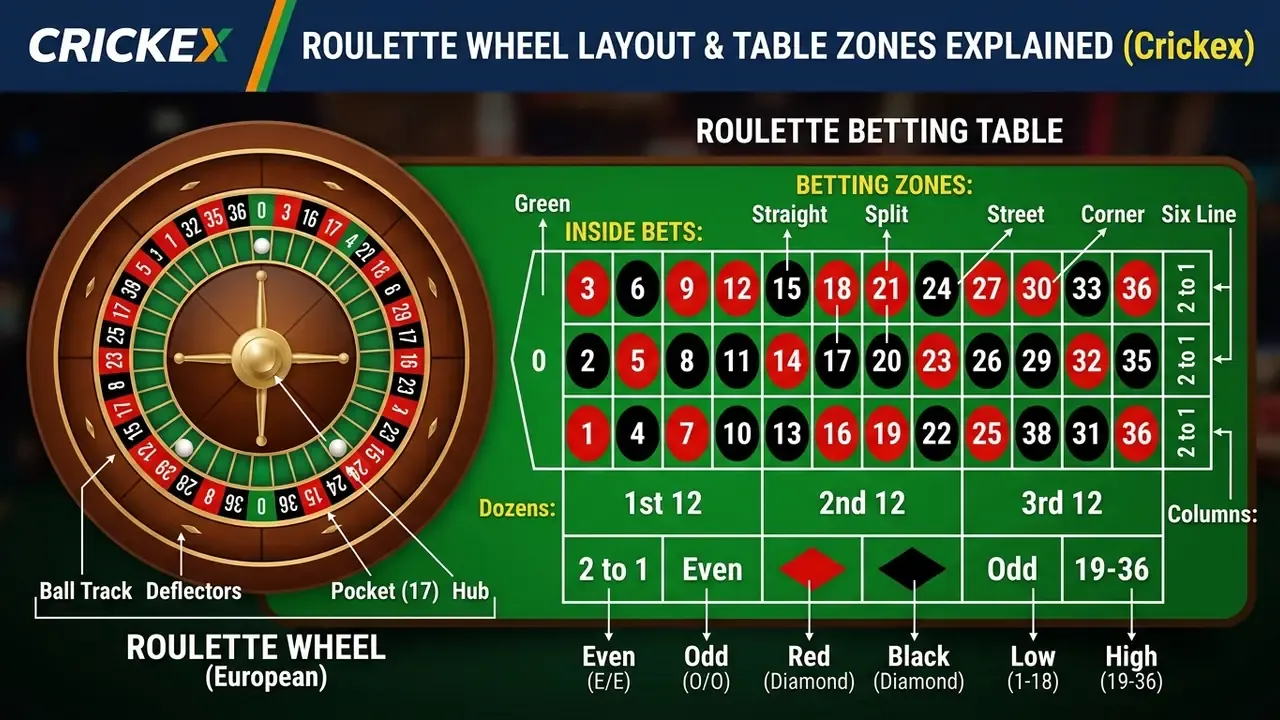
A standard European roulette wheel contains 37 pockets numbered 0 through 36. The numbers are arranged in a fixed, non-sequential order around the circumference: 0, 32, 15, 19, 4, 21, 2, 25, 17, 34, 6, 27, 13, 36, 11, 30, 8, 23, 10, 5, 24, 16, 33, 1, 20, 14, 31, 9, 22, 18, 29, 7, 28, 12, 35, 3, 26. The single green zero occupies one pocket. The remaining 36 pockets alternate between red and black.

This deliberate arrangement distributes colours and high/low numbers as evenly as possible. The design ensures that each pocket has approximately equal probability of catching the ball, and outcomes remain fully independent between spins.

An American roulette wheel features 38 pockets because it adds a double zero (00), also coloured green. That extra pocket has a real mathematical impact on your expected return, which we will cover in detail below.

The roulette table itself is divided into two zones. The inside section contains individual numbers arranged in a 12-row by 3-column grid (1 through 36, plus zero). Players place chips directly on numbers or on the lines between them. The outside section surrounds the grid and offers broader groupings: red/black, odd/even, high/low (1 to 18 or 19 to 36), dozens (1 to 12, 13 to 24, 25 to 36), and columns.

The Roulette Wheel, Table and Betting

How a Roulette Round Is Played from Bet to Result

Every round of roulette follows three stages, whether you are playing roulette at a physical casino, through RNG software, or at a live dealer table.

Betting open. The dealer or software interface signals that the table is accepting bets. You place chips on the betting layout, choosing any combination of inside and outside bets. In online roulette, you click or tap to position virtual chips on the digital layout.

Spin and result. In a physical casino, the croupier launches the ball and announces "no more bets" once it begins to slow down. In RNG-based online roulette, the software generates the winning number through a certified random algorithm the moment you click "Spin." In live dealer roulette, a real croupier spins a physical wheel in a purpose-built studio, with cameras tracking the ball and transmitting the result. Once the ball settles, the winning number and colour are displayed.

Settlement and payout. Losing bets are cleared. Winning bets are paid according to fixed ratios: 35:1 for a straight-up number, 17:1 for a split, 11:1 for a street, 8:1 for a corner, 5:1 for a line, 2:1 for dozens or columns, and 1:1 for even-money outside bets. In online settings, the software automatically credits winnings to your account balance. If a disconnection occurs after the betting window closes, bets are settled based on the actual outcome and appear in your game history upon reconnection.

One thing worth noting: licensed platforms subject their RNGs to testing by independent organisations such as eCOGRA, iTech Labs, and Gaming Laboratories International (GLI). This certification process is a regulatory requirement in jurisdictions including the UK, Malta, and Gibraltar. However, research from the University of Warwick found that risk-related information on online gambling websites is accessible only after opening at least one additional screen, requiring an average of 1.3 mouse clicks, and embedded within pages averaging approximately 2,078 words. Even on regulated platforms, important disclosures can be hard to find quickly.

How a Roulette Round Is Played

Disclaimer: Online roulette involves real financial risk. The information in this guide is educational and does not constitute financial or legal advice. Always gamble responsibly.

Roulette Rules Every Player Should Know

Before you place a single chip, understanding the basic roulette rules saves you from confusion and costly mistakes. The rules are not complicated, but they are strict.

Core Rules of Betting and Settling a Spin

Players must place bets within the designated betting window. Once the dealer announces "no more bets" or the digital timer expires, no further wagers are accepted. The outcome depends solely on where the ball comes to rest, and the table is settled according to the fixed payout structure. No exceptions.

Table limits vary significantly across platforms and table tiers. Online roulette tables commonly set minimums between $0.10 and $50, with maximums reaching tens of thousands of dollars depending on the tier. Land-based casinos may display separate minimum inside and maximum outside limits on the table placard, for example an $11 minimum and $2,500 maximum on outside bets.

French roulette introduces two special rules that apply when the ball lands on zero:

  • La Partage: The dealer splits even-money bets. You receive half your stake back; the house keeps the other half. All other bet types lose in full.
  • En Prison: Even-money bets are "imprisoned" and held for the next spin. If the imprisoned bet wins on the following spin, you recover the original stake but receive no additional payout. If it loses, the stake is forfeited.

Both rules apply exclusively to even-money outside bets (red/black, odd/even, high/low) and reduce the effective house edge from 2.70% to approximately 1.35% on those wagers.

Core Rules of Betting and Settling

"French roulette with the La Partage rule reduces the house advantage to approximately 1.35% on even-money bets." - Industry analysis of online roulette RTP and variant differences.

Common Mistakes Beginners Make When Playing Roulette

Let me be direct here. Most beginner errors come from misunderstanding how the game actually works, not from bad luck.

Myth: You can predict the next spin based on previous results. This is the gambler's fallacy. Roulette spins are independent events. The wheel has no memory. If the previous ten outcomes were all red, the probability of red on the eleventh spin remains 18/37 (48.65%) on a European wheel. The ball does not "know" what happened before.

Myth: Certain dealers or times of day produce better results. This is the illusion of control. Personal rituals, lucky numbers, or timing beliefs have zero effect on a random outcome. Research into gambling cognitions found that loss reappraisal and perceived outcome sequences predict continued play after near-miss outcomes, but ritual beliefs like luck and superstition do not actually improve results.

Myth: A betting system can overcome the house edge. No system changes the underlying mathematics. We will cover this in the strategy section, but the short version: systems reshape how wins and losses are distributed, not whether you win or lose over time.

Practical errors that cost money:

  1. Playing American roulette instead of European or French, nearly doubling the house edge (5.26% vs. 2.70%).
  2. Not setting a bankroll limit before playing, which leads to chasing losses.
  3. Ignoring table limits and payout structures before sitting down.
  4. Confusing inside and outside bet zones on the roulette table.
  5. Assuming demo mode results will translate directly to real money outcomes.
Common Mistakes Beginners Make When Playing

Roulette Bets, Odds and Payouts Explained

Understanding the mathematical profile of each bet type is, well, essential. Without it, you are guessing about your own risk level. Here is how the different betting options break down.

Inside Bets and Their Higher Payouts

Inside bets are placed on specific numbers or small groups of numbers within the grid. They offer higher payouts because the probability of winning is lower.

Bet TypeNumbers CoveredWhere on the LayoutWin Probability (European)Payout
Straight Up1Directly on a single number2.70% (1/37)35:1
Split2On the line between two adjacent numbers5.41% (2/37)17:1
Street3At the end of a row of three numbers8.11% (3/37)11:1
Corner4At the intersection of four numbers10.81% (4/37)8:1
Line6At the intersection of two rows16.22% (6/37)5:1

A straight-up bet on a single number pays 35:1, but you will hit it roughly once every 37 spins on a European wheel. The gap between the true probability and the payout is exactly what creates the house edge.

"The expected return on any wager covering n numbers in American roulette is approximately -5.26% of the stake." - Gambling Tactics: Cashing In on Applied Math, MIT applied mathematics text.

Outside Bets and Why Many Players Use Them

Outside bets cover larger groups of numbers and provide the closest approximation to a coin flip in roulette. They win more often but pay less.

Bet TypeNumbers CoveredWin Probability (European)Payout
Red/Black1848.65% (18/37)1:1
Odd/Even1848.65% (18/37)1:1
High/Low1848.65% (18/37)1:1
Dozen1232.43% (12/37)2:1
Column1232.43% (12/37)2:1

The key detail: even-money bets like red/black have a win probability of 18/37, which is 48.65%, not 50%. That gap, created by the zero pocket, is precisely what generates the house edge. Many beginners overlook this because the bet "feels" like a coin flip. It is not.

For American roulette (38 pockets), probabilities are slightly lower across all bet types because each bet competes against one additional pocket. The five-number bet (covering 0, 00, 1, 2, 3) is unique to the American layout and carries the worst odds on the table:

"The five-number bet (0, 00, 1, 2, 3) has a probability of 5/38, a payout of 6:1, and an expected loss of -7.89%, the worst figure on the table." - Gambling Tactics: Cashing In on Applied Math, MIT applied mathematics text.

Beyond standard inside and outside bets, European and French roulette tables often feature a racetrack, an oval diagram replicating the wheel layout, that enables call bets. These cover groups of numbers as they appear on the physical wheel:

  • Voisins du Zero (Neighbours of Zero):17 numbers around zero, requiring 9 chips.
  • Tiers du Cylindre (Thirds of the Wheel):12 numbers opposite zero, requiring 6 chips as splits.
  • Orphelins:8 numbers not covered by Voisins or Tiers, requiring 5 chips.
  • Neighbours Bets:Any chosen number plus 2 numbers on each side (5 numbers total).
Crickex heading-banner

These sector bets do not change the underlying house edge. Each individual chip within the combination is paid at standard odds. They simply offer a convenient way to cover wheel sections with a single click in online interfaces.

European, American and French Roulette: Different Versions Compared

The three classic roulette variants differ primarily in the number of zero pockets and the application of special rules. Choosing the right version is one of the few decisions that actually affects your mathematical position.

European Roulette and Why Many Players Prefer It

European roulette uses a single-zero wheel with 37 pockets. The house edge is exactly 2.70% (1/37), and the RTP is 97.30%. This makes it the standard choice for most online roulette players and is often considered the best entry point for beginners.

Why do many players prefer it? Simple math. Compared to American roulette, you face roughly half the house edge. Over hundreds of spins, that difference compounds. If you are playing roulette online and have the option, European roulette is almost always the better mathematical choice.

French roulette shares the same single-zero wheel but adds the La Partage or En Prison rules on even-money bets, bringing the effective house edge down to 1.35% and the RTP up to approximately 98.65%. Whenever this variant is available, it offers the best mathematical return in the roulette family.

European Roulette and Why Many Players

American Roulette and the Impact of the Extra Pocket

American roulette adds a double-zero pocket (00), bringing the total to 38 pockets. The house edge jumps to 5.26%, and the RTP drops to roughly 94.74%. Payouts remain the same as European roulette, but your probability of winning any given bet is lower because of that extra pocket.

FeatureEuropean RouletteAmerican RouletteFrench Roulette
Total Pockets37 (0 to 36)38 (0, 00, 1 to 36)37 (0 to 36)
Zero Pockets1 (green 0)2 (green 0 and 00)1 (green 0)
House Edge (standard bets)2.70%5.26%2.70%
House Edge (even-money with rule)2.70%5.26%1.35%
RTP97.30%94.74%98.65% (even-money)
Special RulesNoneFive-number bet availableLa Partage / En Prison

Where is American roulette commonly found? It remains popular in Las Vegas and many US-based casinos. Some online platforms also offer it, sometimes as the default. Always check which version you are playing before placing bets. A site offering only American roulette with a double-zero wheel and lacking responsible gambling tools may indicate a lower standard of player protection.

Roulette Demo vs Real Money Play

One of the first decisions you will face: should you start with roulette demo mode or jump straight into real money roulette? The answer is not as straightforward as "always practice first."

When Demo Roulette Is Useful for Beginners

Demo roulette games use the same RNG software, betting interfaces, and payout logic as their real-money counterparts. The key differences are that you cannot withdraw winnings (because none exist in monetary form) and the psychological experience of risk is fundamentally different when no real money is at stake.

Demo mode serves legitimate purposes when used with realistic expectations:

  1. Learning a new platform's interface. Familiarising yourself with chip placement, navigation, and the betting timer before committing funds.
  2. Testing bet limits and table settings. Understanding how minimum and maximum stakes are configured on a specific table.
  3. Practising rule knowledge. Experimenting with inside bets, outside bets, and call bets to build confidence with different roulette games.
  4. Comparing game variants. Playing European, French, and American roulette side by side to see how rule differences affect gameplay.

Most online casino platforms offer RNG-based roulette in demo mode without requiring registration or a deposit. However, live dealer roulette is generally not available in free-play mode because live tables involve real dealer time and studio costs. You can often watch a live stream briefly before joining, but active participation requires a funded account.

When Demo Roulette Is Useful for

What Changes When You Play Roulette for Real Money

Here is where things get real, literally. A peer-reviewed study published in PubMed describes simulated gambling as structurally identical to real-money gambling in rules and reinforcement patterns, but without direct financial risk. That distinction matters more than most players expect.

Research shows that the transition from demo to real money is not neutral. A study on free-play modes found that participants exposed to inflated-profit demo modes placed significantly higher bets when transitioning to real-money play.

"Participants exposed to inflated-profit demo modes placed significantly higher bets when transitioning to real-money play." - Exposure to Free-Play Modes in Simulated Online Gaming Increases Risk-Taking in Monetary Gambling.

This is concerning because many demo roulette games do not accurately represent the financial outcomes you would experience over time with real money. If the demo produces more frequent or larger wins than statistical reality would predict, you may develop inflated confidence in your ability or your chosen strategy. That confidence can evaporate rapidly when real bankroll depletion occurs.

Further evidence from longitudinal research involving adolescents found that 12% of young people in a study sample first reported monetary gambling at the second wave, and this transition was associated with simulated gambling on social media and advertising exposure.

The practical takeaway: set your stake sizes based on your real-money bankroll limits, not on your demo-mode experience. Demo play is a learning tool, not a prediction of future results.

This is concerning because many demo

Live Dealer Roulette and Live Casino Experience

Roulette live dealer format has become one of the fastest-growing segments in online gambling. The live dealer casino market was sized at USD 8.6 billion in 2025 and projected to reach USD 21.3 billion by 2034. There is a reason for that growth: it bridges the gap between online convenience and the atmosphere of a real casino floor.

How Live Roulette Works Online

Live dealer roulette operates from purpose-built studios equipped with professional-grade camera systems. High-speed cameras monitor the roulette wheel continuously. The ball's path is tracked through motion analysis, and Optical Character Recognition (OCR) technology identifies the final winning pocket the moment the ball comes to rest. The detected result is confirmed and broadcast simultaneously to every connected player, synchronising the live video feed with the digital betting interface in real time.

Evolution Gaming's Lightning Roulette exemplifies innovation in the live format. It retains the standard European roulette structure (37 pockets) but adds an RNG-driven Lucky Number feature: between one and five numbers are randomly given multiplied payouts of between 50x and 500x on straight-up bets each round. To compensate, standard straight-up payouts are reduced from 35:1 to 29:1. The game won Product Innovation of the Year at the Global Gaming Awards and was voted EGR's Game of the Year 2018. Native-speaking versions are available in multiple languages including Hindi.

XXXtreme Lightning Roulette extends this concept with Chain Lightning (up to nine additional multiplied numbers per round) and Double Strike Multipliers that can push payouts up to 2,000x on a single straight-up bet.

Immersive Roulette uses multiple camera angles and slow-motion replays to recreate the visual drama of watching the ball settle. It provides a cinematic experience unique to the live-streamed format.

How Live Roulette Works Online. Live

Who Should Choose Live Dealer Roulette

Not everyone needs live dealer roulette. Here is a practical breakdown:

CriterionRNG Online RouletteDemo (Free-Play) RouletteLive Dealer Roulette
Pace of PlayFastest (instant spin, player-controlled)Same as RNGSlower (real-time wheel spin, roughly 25 to 60 seconds per round)
ImmersionLow (software graphics)Low (identical to RNG visually)High (real dealer, studio setting, chat function)
Learning ValueModerateHighest (zero financial risk)Lower (real-time pace leaves less room for deliberation)
Financial PressurePresent (real-money bets)None (virtual credits only)Present (often higher minimum stakes)
Availability24/7, any device24/7, usually no registration required24/7 on most platforms, requires funded account
Social InteractionNoneNoneYes (live chat with dealer and other players)
Trust FactorDepends on RNG certificationN/AHigher for many players (visible physical wheel)

Complete beginners should start with demo mode to learn bet types and interface navigation without financial risk. Transition to low-stakes RNG roulette when comfortable.

Experienced table-game players will find live dealer roulette offers the closest experience to a land-based casino, with the convenience of home play.

Players seeking speed will prefer RNG roulette, which allows the fastest pace with no waiting for other players or dealer actions.

Players who value trust and visibility often gravitate toward live dealer tables because they can watch the physical wheel spin in real time.

Complete beginners should start with demo

Roulette Strategy: What Can and Cannot Improve Your Results

Let me be honest about something. The word "strategy" in roulette is, well, a bit misleading. Unlike poker or blackjack, roulette offers no decisions that change the mathematical odds. Every spin is independent. The house edge is fixed. No betting pattern alters that.

So what can strategy actually do? It can help you manage your money, control your session length, and choose lower-volatility bets. That is genuinely useful. But it cannot turn a negative-expectation game into a profitable one.

Bankroll Management and Bet Sizing

Because betting systems cannot change the house edge, the most practical area where you can exercise genuine control is bankroll management: how much money to allocate, how to size bets, and when to stop.
  • Fixed Stake:Bet the same amount on every spin. Common guidance sets the unit at 1 to 5% of the total bankroll. For a $200 bankroll, this means individual bets of $2 to $10.
  • Proportional Betting:Each bet is a fixed percentage of your current bankroll (not the starting bankroll). A 2% rule on a $200 bankroll means a $4 first bet. If the bankroll drops to $180, the next bet is $3.60. This automatically scales down exposure during losing runs.
  • Unit-Based Session Management:Divide the session bankroll into 40 to 50 equal units. Once all units are lost, the session ends. This is essentially a structured stop-loss.
Bankroll Management and Bet Sizing. Because

Stop-loss rules vary across sources. Some define the threshold as 100% of the session bankroll (play until it is gone), while others use 20 to 25% of the total bankroll as a session cap. The key principle: only stopping rules can limit actual monetary loss, but they cannot change the expected value of the game.

"Even with a small house advantage, infinite play leads to ruin with high probability; only stopping rules limit losses." - Statistical analysis of the roulette Martingale system.

Why No Roulette Strategy Removes the House Edge

The Martingale System instructs you to double your bet after every loss and return to the base bet after a win. Starting with a $5 bet on red, a loss leads to $10, then $20, then $40, and so on. Each win recovers all previous losses plus a net profit equal to the original base bet. Sounds perfect, right?

Here is the problem. Starting at $5 with a table maximum of $500, you can only double seven times (5, 10, 20, 40, 80, 160, 320). Seven consecutive losses, an event with a probability of approximately 1.4% per sequence on an American wheel, would exhaust the progression and produce a cumulative loss of $635. The Martingale player wins $5 frequently but faces a small yet inevitable risk of catastrophic loss that, over time, more than offsets the accumulated small gains.

Why No Roulette Strategy Removes the

"The expected return under the Martingale system remains negative; the distribution of outcomes is heavily skewed, frequent small wins are offset by rare catastrophic losses." - Statistical analysis of the roulette Martingale system (technical report with simulations in R).

The D'Alembert System increases the stake by one unit after a loss and decreases by one unit after a win. Gentler than the Martingale, but the expected value per spin remains identical.

The Fibonacci System follows the Fibonacci sequence (1, 1, 2, 3, 5, 8, 13, 21...) after losses and steps back two positions after a win. Slower escalation, same core limitation.

The Paroli (Reverse Martingale) System doubles your bet after each win and returns to the base bet after a loss. It capitalises on winning streaks while limiting losses during losing runs. Important distinction: Martingale doubles on a loss; Paroli doubles on a win. Confusing the two is a common error.

The D'Alembert System increases the stake

Important: No betting system can change the mathematical house edge in roulette. The house advantage remains 2.70% (European), 1.35% (French, even-money), or 5.26% (American) regardless of the staking pattern. Systems reshape the distribution of outcomes but do not alter the expected value of the game.

The Ashley Revell story illustrates this perfectly. In 2004, this British man sold all his possessions, totalling approximately $135,300, and placed the entire sum on red at the Plaza Hotel & Casino in Las Vegas. The ball landed on Red 7, and he walked away with roughly $270,600. Inspiring? Perhaps. But it was a single spin with a 48.65% chance of doubling his life savings and a 51.35% chance of losing everything. The expected value of his bet was negative. The outcome does not validate the approach.

How to Choose the Best Roulette Casino Online

Finding a trustworthy online roulette casino requires more than checking the first search result. The difference between a well-run platform and a problematic one often comes down to details that are easy to verify if you know where to look.

What to Check Before You Play at an Online Roulette Casino

Before depositing money at any online casino, go through this checklist systematically. These criteria are derived from independent review agencies and regulatory bodies:

  • Verify the licence. Check the casino's footer or "About" page for a licence issued by a recognised regulator (UK Gambling Commission, Malta Gaming Authority, Gibraltar Gambling Commissioner, Curacao eGaming). Cross-reference the licence number on the regulator's public register.
  • Confirm independent game auditing. Look for certification marks from eCOGRA, iTech Labs, or GLI, which verify that RNG outcomes are statistically fair.
  • Check roulette variant availability. Ensure the platform offers European or French roulette (house edge 2.70% or 1.35%) rather than only American roulette (5.26%). A site offering only American roulette without responsible gambling tools may indicate a lower standard of player protection.
  • Test the demo mode. Open a free-play roulette game and confirm that the same rules, bet limits, and interface are available without depositing real money.
  • Verify live dealer availability. If live roulette matters to you, confirm the casino partners with a reputable provider (Evolution Gaming, Playtech) and that studio-quality live tables are accessible.
  • Review payment methods and payout times. Confirm your preferred deposit and withdrawal methods are supported. For India-based players, check for INR support, UPI, NetBanking, or popular e-wallets. Look for payout timeframes of 0 to 3 business days as a benchmark, and understand KYC verification requirements before attempting a withdrawal.
  • Read the bonus terms carefully. Roulette often contributes only 5 to 10% toward bonus wagering requirements (compared to 100% for slots). A typical wagering requirement of 35x on a $100 bonus means $3,500 in total wagers. At 10% contribution, roulette play would need $35,000 in bets to clear the bonus. Always read the specific terms before accepting a promotion.
  • Check responsible gambling tools. Deposit limits, loss limits, session time limits, cooling-off periods, and self-exclusion options should all be available and easy to configure.
  • Look for mobile usability. Approximately 58% of online roulette bets are placed from mobile devices. Test the platform on your phone before depositing.

Red flags that should prompt immediate caution:

  • Excessive withdrawal delays (payouts taking months, or repeated requests for "additional verification" without resolution)
  • Account closures without warning after requesting a withdrawal
  • Misleading licence claims (displaying a regulator's logo without actually holding a valid licence)
  • Unresponsive customer support on payment disputes
  • No responsible gambling tools whatsoever
  • Unrealistic bonus promises (e.g., 500% deposit match) with unplayable wagering requirements

When in doubt, consult independent review platforms that publish detailed methodologies for their ratings, and cross-reference any casino's licence number directly with the issuing regulatory body.

What to Check Before You Play

Disclaimer: This checklist is for informational purposes only and does not constitute an endorsement of any specific platform. Regulatory requirements and platform features change frequently. Always verify current information directly with the operator and relevant regulatory body.

Responsible Gambling: Setting Limits Before You Play

This section is not a footnote. It belongs here, before you make any decisions about depositing or playing.

Research consistently shows that warning labels and pop-up messages have limited effectiveness as standalone interventions. University of Warwick research found risk information on online roulette sites hidden behind 1.3 clicks and buried in texts averaging 2,078 words. In experimental settings, pop-up warnings had no significant effect on bet sizes or duration of real-money play.

"Pop-up warnings in a demo experiment had no significant effect on bet sizes or duration of real-money play." - Exposure to Free-Play Modes in Simulated Online Gaming Increases Risk-Taking in Monetary Gambling.

What does work? Active, pre-set limits. Most licensed online casinos provide tools including deposit limits, loss limits, session time limits, cooling-off periods, and self-exclusion options. Configure these tools before beginning a gambling session, not after losses have occurred.

GamCare advises: "Know how the games work before you wager" and "Don't depend on 'good luck' strategies, they don't increase your chances of winning."

BeGambleAware guidance states: "The odds are that you will lose" and recommends avoiding chasing lost money, framing gambling as entertainment, not a source of income.

For players in India specifically, it is worth noting that online gambling regulations vary by state. There is no single national law that clearly permits or prohibits all forms of online casino play. Before depositing, understand the legal landscape in your specific state and be aware that payment processing for gambling transactions may face restrictions through certain Indian banking channels.

If you recognise signs of problem gambling in yourself or someone you know, reach out to support organisations:

  • GamCare (gamcare.org.uk) for confidential support
  • BeGambleAware (begambleaware.org) for guidance and resources
  • National Council on Problem Gambling (ncpgambling.org) for US-based support

Set limits. Stick to them. Treat roulette as paid entertainment with a known cost, not as a way to make money.

What does work Active, pre-set limits

FAQ About Playing Roulette Online

Is roulette suitable for complete beginners?

Yes. Roulette has simpler rules than most casino games. Start with demo mode to learn the roulette table layout and bet types without financial risk. When you feel comfortable, move to low-stakes European roulette online.

What is the difference between RNG roulette and live dealer roulette?

RNG roulette uses software to generate results instantly. Live dealer roulette streams a real croupier spinning a physical wheel in real time. Both formats follow the same rules and odds, but live roulette offers social interaction and the visual reassurance of a physical wheel. RNG roulette is faster and usually has lower minimum bets.

Does live dealer roulette feel closer to a real casino?

For many players, yes. The presence of a real dealer, the sound of the ball, and the ability to chat create an atmosphere closer to a land-based casino. However, the pace is slower (25 to 60 seconds per round versus instant spins in RNG mode), and minimum stakes tend to be higher.

Can I play roulette for free without registering?

Most online casino platforms offer RNG-based roulette in demo mode without requiring registration or a deposit. Live dealer roulette is not available in free-play mode because it involves real dealer time and studio costs.

What are the main bet types in roulette?

Two main categories: inside bets (placed on specific numbers or small groups, such as straight-up, split, street, corner, line) and outside bets (covering larger groups, such as red/black, odd/even, high/low, dozens, columns). Inside bets offer higher payouts but lower probability. Outside bets offer lower payouts but win more frequently.

What do roulette bets pay?

Even-money bets (red/black, odd/even, high/low) pay 1:1. Dozens and columns pay 2:1. A straight-up single-number bet pays 35:1. A split pays 17:1, a street 11:1, a corner 8:1, and a line 5:1.

What happens when zero or double zero hits?

On standard European and American roulette, all outside bets (red/black, odd/even, high/low) lose when zero hits. Inside bets on the zero number itself win at 35:1. On French roulette tables with La Partage, even-money bets lose only half the stake. With En Prison, the bet is held for the next spin.

Can any roulette strategy guarantee a profit?

No. Every betting system (Martingale, D'Alembert, Fibonacci, Paroli) changes how bets are sized but does not alter the mathematical house edge. The expected value of each spin remains negative for the player. Responsible gambling organisations including GamCare and BeGambleAware explicitly advise that no strategy increases the chances of winning.

How do I get started with roulette play?

Choose a licensed online casino that offers European or French roulette. Test the demo mode first. Set deposit and session limits before playing with real money. Read the bonus terms carefully, especially the roulette contribution percentage. And remember: roulette is entertainment with a built-in cost, not a path to income.

This guide is for educational and informational purposes only. Gambling involves financial risk, and the mathematical house edge ensures that the casino retains an advantage over time. No strategy, system, or approach can guarantee profit. If you or someone you know is struggling with gambling, please contact GamCare (gamcare.org.uk), BeGambleAware (begambleaware.org), or the National Council on Problem Gambling (ncpgambling.org) for confidential support.