Table of Content

Blackjack online: rules, strategy, demo and real money play

18+ | Play Responsibly. Gambling involves financial risk and is not a guaranteed source of income. Please verify the laws in your jurisdiction before playing for real money.

"In our reviews over the past years, we tested dozens of platforms catering to Indian users. The main takeaway is simple: a big bonus is not always better value. Before you deposit, you must understand table limits and verifiable payout rules." - Nisha Rao, Casino and Betting India

Volatility

Low

Min bet

₹100

Max bet

₹50,000

Blackjack online rules, strategy, demo and

What you will learn: This guide covers the complete blackjack ruleset, card values, optimal basic strategy, the difference between demo and real-money play, how live dealer tables work, bonus wagering math, and how to choose a safe blackjack casino in India. Every section is written to help you make mathematically sound decisions before you risk your bankroll.

Online blackjack remains a fixed sequence of standard actions where player strategy directly impacts the math. Modern players encounter different formats: purely algorithmic tables, free-to-test modes, and streamed physical games. This guide breaks down the core mechanics, verifiable safety checks, and practical strategies needed before you risk your bankroll.

What you will learn This guide

What is blackjack and how the game works

Blackjack is a player-versus-dealer card game where the goal is to beat the dealer's score without exceeding 21 points. You do not compete against other players at the table. Every decision you make influences the possible payout. Playing blackjack requires understanding that both the player and the dealer must follow a rigid framework of rules. The overall game pace and mechanics remain identical whether you play a physical game or a digital blackjack game.

Worth noting: this simplicity is exactly what draws people in. But simplicity does not mean the game is easy to master.

The objective of blackjack and when a hand wins

The objective of blackjack is to achieve a hand total closer to 21 than the dealer, without going over. A hand wins if its final value is higher than the dealer's total. If a player's hand goes over 21, that is a bust. A bust means an automatic loss, regardless of what the dealer draws next.

A natural blackjack is the strongest initial hand you can hold. This specific combination consists of an Ace and any 10-value card dealt as your first two cards. It totals exactly 21. Natural blackjacks usually receive a higher payout ratio than standard hands, typically 3:2. If the dealer also holds a natural 21, the round is a push. A push means your current bet is returned, and neither side wins. You must verify the specific win conditions before you play, as house rules dictate exactly how ties and natural combinations are resolved.

The objective of blackjack and when

When neither player nor dealer exceeds 21, the hand closest to 21 wins; equal totals result in a push and the bet is returned. This core comparison principle is the mathematical foundation of every blackjack hand.

How a standard blackjack round moves from bet to payout

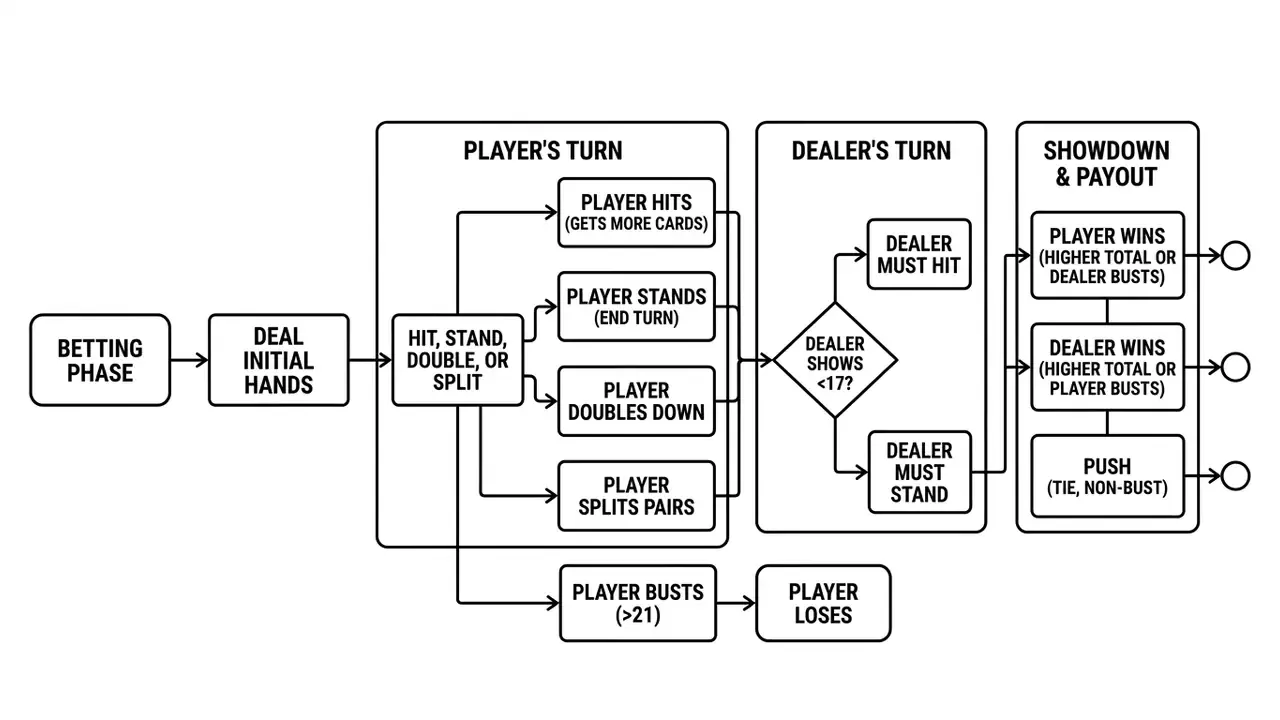
A standard blackjack round follows a strict sequence: place your wager, receive your initial two cards, make your strategic decisions, watch the dealer act, and receive the payout. You start by placing virtual chips in the betting circle. The operator's software then locks your wager.

Cards are dealt clockwise. You receive two face-up cards. The dealer receives one face-up card and one face-down card. The software then prompts the player for decisions. You can choose to hit, stand, double, or split. Once your turn ends, the dealer reveals their hidden card. The dealer must draw or stand based on strict numeric limits, hitting on 16 or lower, standing on 17 or higher. Finally, the system calculates the totals and distributes payouts to winning hands immediately.

If you have never played before, the whole thing takes about 30 seconds per hand online. That speed can catch you off guard.

How a standard blackjack round moves
The standard blackjack game flow

Blackjack rules every player should know

Blackjack rules govern the exact point value of the cards, the actions available to the player, and the automatic logic the dealer must follow. Understanding these blackjack rules is the only way to make mathematically sound decisions. Without knowing what each card is worth, determining the risk of busting is impossible. Every table sets limits on maximum wagers, maximum hands, and specific table modifications.

Card values from 2 to Ace

Card values in blackjack are static, except for the flexible Ace. Below is a quick-reference cheat sheet you can screenshot and keep on your phone:
  • Cards 2 to 10:Worth their printed face value (e.g., a 7 is worth 7 points).
  • Jack, Queen, King:Each worth exactly 10 points.
  • Ace:Worth 1 or 11. It starts as 11, but drops to 1 if the total would exceed 21.
Card values from 2 to Ace

A hand holding an Ace valued at 11 is called a "soft" hand. A hand with no Ace, or an Ace forced to act as a 1, is a "hard" hand. Soft hands allow for more aggressive drawing because one hit will not bust the player. Hand totals are computed by summing all card values together. This distinction between soft and hard hands matters more than most beginners realize, and it shapes nearly every strategy decision you will face.

Player actions: hit, stand, double and surrender

Player actions define how you navigate your hand after the initial deal. A "hit" means you request one additional card to increase your total. A "stand" ends your turn and locks your current score.

A "double down" allows you to double your initial wager in exchange for exactly one more card. You are forced to stand afterward. Some tables restrict which first-two-card hands may double. "Surrender" lets you fold your hand right after the deal. If the table allows late surrender, you give up half your bet to save the rest. Surrender is allowed only on the first two cards under late-surrender rules.

Player actions hit, stand, double and

Situation: A new user constantly lost money on hard 16 against a dealer's 10. Action: We guided the user to check table rules for the late surrender option. Result: By utilizing surrender mathematically, the user reduced their expected loss rate on weak hands significantly.

Dealer rules, payouts and insurance

Dealer rules remove all human choices from the house's side of the game. A standard dealer must hit on an overall total of 16 or lower. They must stand on 17 or higher. Some tables require the dealer to hit a soft 17 (H17), which slightly increases the casino's advantage compared to standing on all 17s (S17).

Standard winning hands are paid out at 1:1. A classic natural blackjack pays at 3:2. Be wary of tables that pay only 6:5 for blackjack, because this increases the house edge significantly. Insurance is an optional side bet offered when the dealer's visible card is an Ace. It costs half your original bet and pays 2:1 if the dealer holds a natural 21. Statistics prove that taking insurance is a mathematically weak choice. At optimal basic strategy with favorable rules, the house edge sits at roughly 0.55%, one of the lowest in any casino game. Declining insurance is part of that optimal play, because the bet has a negative expected value unless you have specific knowledge of the remaining deck composition.

Dealer rules, payouts and insurance. Dealer
ActionWhen it appliesEffect on handEffect on bet
HitWhile total is 21 or lessAdds one card to totalNo change to current wager
StandAnytime after the dealLocks total and ends turnNo change to current wager
DoubleOn first two cardsAdds exactly one cardDoubles the original stake
SplitOn two cards of equal valueDivides into two separate handsRequires a matching new bet
SurrenderOn first two cards before actingForfeits the hand immediatelyLoses 50% of the initial bet

How to play blackjack online

Playing blackjack online requires interacting with digital chips, timing windows, and specific software interfaces. The core math remains identical to physical rooms, but the digital pace is much faster. Online blackjack limits the mental friction by automatically calculating totals. Mobile accessibility means your local connection stability is a priority.

Choosing a blackjack table and placing your first bet

Choosing a blackjack table requires checking the betting limits, the number of decks, and the specific house rules. Your first action in a blackjack casino is tapping an open virtual seat. Limits are clearly displayed as a minimum and maximum figure, for example, ₹100 min / ₹50,000 max.

You place your first wager by tapping the digital chip values on your screen. You then click the empty betting box. Always compare the table limits with your comfortable bankroll. A high-limit table burns a small budget rapidly. Set a clear walk-away point before you place that first wager. Additionally, check whether the table uses S17 or H17 rules, whether double-after-split (DAS) is allowed, and how many decks are in play. These factors directly affect your expected return.

Here is a practical example. Suppose your session budget is ₹5,000. A table with a ₹500 minimum bet gives you only 10 base hands before you are out. A ₹100 minimum table gives you 50 hands, which is enough room to actually apply strategy. Table selection is bankroll management.

Choosing a blackjack table and placing

What happens after the deal in online blackjack

After the cards are dealt, the software governs the sequence of play. In algorithmic RNG blackjack online, a random number generator determines the outcome in milliseconds. The server algorithm verifies the client seed and applies the predetermined card order.

The UI displays buttons for hit, stand, double, or split. If you play on mobile, you have a short time window, often 15 seconds, to log your choice. Once your turn is complete, the software draws the dealer's cards instantly. Winning and losing conditions are assessed simultaneously. The casino balance updates without human intervention.

What happens after the deal in

Blackjack strategy for beginners

Blackjack strategy relies on math, not intuition. Choosing your move based on a hunch increases the casino's advantage. Computer simulations confirm that a beginner applying an optimal blackjack strategy can lower the house edge to approximately 0.55% under standard conditions. Ignoring strategy pushes that edge aggressively higher. Focus on statistical probability.

Basic strategy decisions by hand value

Basic strategy dictates your decisions based entirely on your hand total and the dealer's visible card. Below are the core rules formatted for quick reference:

Hard totals:

  • Hard 8 or less: Always hit.
  • Hard 9: Double against dealer 3 through 6; otherwise hit.
  • Hard 10: Double against dealer 2 through 9; hit against 10 or Ace.
  • Hard 11: Always double down. This is mathematically one of the strongest plays available.
  • Hard 12: Stand against dealer 4, 5, or 6 (high probability of dealer busting); hit against everything else.
  • Hard 13 through 16: Stand against dealer 2 through 6; hit (or surrender if available) against 7 or higher.
  • Hard 16 vs dealer 10: Surrender if allowed; otherwise hit.
  • Hard 17 or above: Always stand.

Soft totals:

  • Soft 17 (Ace + 6): Always hit or double against dealer 3 through 6.
  • Soft 18 (Ace + 7): Hit against dealer 9, 10, or Ace. Beginners often stand here, but the math favors drawing.
  • Soft 19 or above: Always stand.

Pairs:

  • Always split Aces and 8s. Two 8s make a hard 16, the worst hand in blackjack, but two separate 8-start hands are far stronger.
  • Never split 10s or 5s.
  • Split 2s, 3s, 6s, and 7s against dealer 2 through 7.

A full basic strategy chart can vary slightly by the number of decks and specific house rules, but these core principles remain consistent. Consider saving a strategy chart image on your phone for quick reference during play. Actually, I would say this is one of the most practical things you can do as a beginner. Having the chart open while playing blackjack online removes guesswork entirely.

Basic strategy decisions by hand value

Common mistakes new players make

Impulsive betting and ignored rules destroy beginner bankrolls. The most expensive mistake is taking insurance. Insurance is mathematically hostile unless you count cards perfectly, which online shuffling mechanisms prevent.

Situation: A new player consistently placed an insurance bet every time the dealer showed an Ace. Action: We instructed them to review the payout probability structure of insurance bets. Result: The player stopped using insurance, immediately stretching their operational budget by over 15%.

Another mistake is standing on a soft 17. Beginners assume 17 is a safe endpoint. In reality, a soft 17 cannot bust on a hit, making an aggressive draw the correct choice. New players often refuse to split a pair of 8s out of fear of doubling their risk. That fear is understandable, but the math is clear.

Research on blackjack player psychology confirms this pattern: across two controlled experiments, unjustified confidence consistently led to larger bets and less use of strategy aids. - "Thinking without knowing: Psychological and behavioral consequences of unjustified confidence regarding blackjack strategy" (2023).

Finally, poor budget discipline is a universal error. Studies of online casino betting behavior show that players increase bets after both immediate losses and wins, but reduce session length only after accumulated losses, a pattern consistent across blackjack and slots. Set limits before playing blackjack and accept that losses are part of the mathematical structure.

Another mistake is standing on a

FACT CHECK: "Can card counting guarantee a win online?" No. Card counting relies on deck penetration, meaning knowing which cards remain in the shoe. RNG algorithms shuffle the entire virtual deck after every hand. Live dealer blackjack tables frequently use Continuous Shuffling Machines (CSM) or swap shoes regularly. When continuous shuffling is present, the remaining deck composition never accumulates meaningful information, and the mathematical foundation of counting collapses. Play for entertainment, not guaranteed returns.

Blackjack demo vs real money play

The difference between a blackjack demo and real-money modes is purely financial risk. The rules, card dealing algorithms, and visual interfaces are the same. Demo modes use virtual credits. Blackjack real money directly impacts your deposited funds.

When blackjack demo is useful

Blackjack demo mode is a practical tool for memorizing basic play without exposure to risk. It allows you to test hit and stand theories against a live algorithm. A demo helps you adjust to the speed of the software.

Practicing free hands reveals how fast an RNG table operates. It helps you memorize the value of soft and hard configurations. Treat the demo as a training ground for game pace. Do not view short-term demo wins as a promise of future profitability.

Laboratory research on simulated gambling found that participants who played demo modes with inflated win rates made significantly larger bets when they transitioned to real-money play. This confirms that demo outcomes can create false expectations about real-money results. Keep that in mind. A winning streak in demo blackjack does not mean the real blackjack table owes you anything.

When blackjack demo is useful. Blackjack

What changes in blackjack real money games

Real money play introduces psychological friction. When actual money is on the line, losses become measurable. Players often abandon logic. Research demonstrates that unjustified confidence developed during practice sessions increases wager sizes and reduces information-seeking behavior, directly raising financial risk. - "Thinking without knowing: Psychological and behavioral consequences of unjustified confidence regarding blackjack strategy" (2023).

Unjustified confidence developed during a demo can lead to escalated wagers in real blackjack. Players chase losses to recover budgets. Winning streaks prompt reckless bet increases. Real blackjack demands strict budget limits and a pre-planned stop protocol. Treat this entertainment logically. Choose lower stake limits if the pressure affects your mathematical choices.

What changes in blackjack real money

LEGAL AND RISK NOTE: Real money gambling involves direct financial risk. It is not a path to guaranteed income. Casino availability in India varies heavily by state laws (e.g., restricted in Andhra Pradesh and Telangana). Content provided is informational. Always verify local jurisdiction laws and set a hard session budget before you deposit.

Disclaimer: The information in this article is intended for general educational purposes only. It does not constitute legal, financial, or professional gambling advice. Please check the gambling regulations applicable in your state or territory before placing any real-money bets.

How to choose a blackjack casino before you play

To find a reliable blackjack casino, Indian users must verify payout channels and transparent rules. Promotional hype often hides complex requirements. Trust relies on evaluating payment speed, specific bonus restrictions, and the variety of available blackjack tables. Player safety always comes before claiming a flashy welcome offer.

Bonuses, payouts and table selection

Getting the highest bonus value requires reading the fine print. Casinos regularly restrict the wagering contribution of blackjack. Slots usually contribute 100% toward clearing a bonus. Blackjack often contributes only 5% or 10%. Casinos limit blackjack's contribution specifically because it carries a low house edge, roughly 0.5% with optimal play, making it too efficient for bonus clearing compared to slots.

How to calculate wagering requirements for blackjack: If a casino offers a ₹10,000 bonus with a 40x wagering requirement, but blackjack only contributes 10%, you must wager ₹40,00,000 (₹10,000 x 40 x 10) at the blackjack table to clear the bonus. At a 0.55% house edge with perfect strategy, your expected loss during that wagering would be approximately ₹22,000, more than double the bonus value. This is why bonus math matters: a large bonus with poor blackjack contribution can actually cost you money.

A large bonus is useless if you cannot withdraw it. Check the precise payout rules. For users in India, UPI and NetBanking transaction speeds are vital. Fast payouts are a sign of liquidity. Look for a gaming lobby offering a wide selection of blackjack games. The platform should offer micro-limits for casual users and VIP tables for larger bankrolls. Also be aware that before your first withdrawal, most online casinos for Indian players will require KYC (Know Your Customer) verification, typically your PAN card or Aadhaar. Complete this step early to avoid delays when you want to cash out.

Bonuses, payouts and table selection. Getting

Red flags when choosing a blackjack casino

Before you deposit, scan for these warning signs:

  • No license displayed in the footer. A legitimate platform proudly links to its regulatory license (e.g., Curacao, MGA, or UKGC).
  • No INR deposit option. If the casino does not support Indian Rupees, you will face conversion fees and potential payment issues.
  • Customer support only via email. Reliable platforms offer 24/7 live chat. Email-only support often means slow resolution during disputes.
  • Vague or missing bonus terms. If you cannot find wagering requirements, game contribution percentages, and maximum bet limits in the T&Cs, treat it as a red flag.

One more thing to watch for: if a casino blackjack page makes income promises or guarantees winnings, walk away. No legitimate operator does that.

Red flags when choosing a blackjack

Security, software and mobile access

A secure casino deploys modern cryptography and undergoes public audits. Look for valid HTTPS/TLS certificates protecting the login flow. Regulated platforms display certificates from neutral auditors like iTech Labs or eCOGRA. These labs verify the fairness of the random number generators. Organizations such as eCOGRA test RNG implementations to confirm that card distributions match the stated RTP values.

Mobile access is non-negotiable for modern gaming. The app or browser interface must load seamlessly. A heavy, lagging interface can cause accidental wagers. Ensure the platform supports secure mobile transactions without freezing. Check whether customer support operates during Indian business hours. If you primarily play blackjack on your phone, test the lobby speed before depositing. A slow-loading table during a timed decision window is not just annoying, it can cost you a hand.

Security, software and mobile access. A

Live dealer blackjack and live casino format

Live dealer blackjack merges an authentic table atmosphere with virtual betting structures. Instead of pure software rendering the cards, a human handles a physical deck. Blackjack live casino streams bring actual dealing into your browser. This creates a distinct visual rhythm compared to computer-generated rounds. Players looking for this experience can explore live casino platforms that stream HD tables directly to mobile and desktop.

How live blackjack works at online tables

Live blackjack operates through high-definition video capture and optical character recognition (OCR). The human dealer draws physical cards from a smart shoe. The table features hidden sensors that scan every card instantly.

Your mobile screen displays the digital values of the scanned physical cards. A betting window opens between rounds. You lock your digital wager on your device. The dealer watches a hidden monitor displaying aggregated player bets and decisions. They deal the physical cards accordingly. The digital interface handles all payouts securely.

The experience feels closer to sitting at a real casino table. You can often chat with the dealer, which adds a social layer that RNG blackjack simply cannot replicate.

How live blackjack works at online

Top live blackjack software providers

The quality of your live blackjack experience depends heavily on the software provider behind the table. Here are the dominant names you will encounter:

Evolution Gaming is the current market leader in live casino. They operate studios in Latvia, Canada, Malta, and the UK, offering over 200 live blackjack tables with features like Infinite Blackjack (unlimited seats) and Lightning Blackjack (random multipliers). Camera zooms and multiple angles create what the industry calls a "cinematic" dealing experience. Evolution tables typically feature minimum bets from ₹50 up to ₹50,00,000+ on VIP tables.

Playtech provides premium, studio-quality live blackjack streams primarily from European locations. Known for strong regulatory approval across multiple jurisdictions, Playtech offers exclusive blackjack variants and branded private rooms for VIP players. Their UI is polished, and they support a broad set of dealer languages including Hindi and English.

Other providers you may encounter include Ezugi (popular in India for localized tables) and Pragmatic Play Live, which is expanding rapidly with competitive low-limit tables. If you are new to live dealer blackjack, Ezugi tables can feel more familiar because of the India-specific presentation.

Top live blackjack software providers. The

RNG blackjack vs live dealer blackjack

RNG blackjack is mathematically opaque but heavily audited for fairness. Live dealer blackjack offers visual verification of the deal. RNG rounds are significantly faster. A digital table can cycle 200 to 300 hands per hour. Live tables move at a human pace.

Simulations show RNG blackjack carries a house edge of approximately 0.5%, while live dealer blackjack sits at roughly 0.6% under comparable rules, a marginal difference driven by slightly different rule sets and dealing speeds.

Live formats carry higher user trust due to the visible card shuffling. A player who fears algorithmic manipulation often prefers human dealers. However, RNG tables often feature lower minimum stakes. Industry data indicates that players spend an average of 36 minutes per session at live tables versus 18 minutes at RNG tables, roughly twice as long, driven by the slower tempo and social presence of a human dealer. Consider the tempo you prefer before committing funds.

RNG blackjack vs live dealer blackjack
FeatureDemo BlackjackRNG Real MoneyLive Dealer Blackjack
Financial riskNone (virtual credits)HighHigh
MechanicsAlgorithmic RNGCertified algorithmic RNGPhysical cards + video OCR
Speed / PaceVery fastVery fast (up to 300 hands/hr)Slower (human dealing, ~60 hands/hr)
Social immersionNoneLowHigh (dealer chat, live video)
Typical house edgeN/A~0.5%~0.6%
Minimum stakesFreeOften lower (₹10+)Often higher (₹50 to ₹500+)

To summarize the table above: demo blackjack is for learning, RNG is for fast solo sessions, and live dealer blackjack is for players who want the atmosphere of a real casino floor. Each format suits a different mood and budget.

Blackjack game variants you may see online

Many operators provide blackjack games with custom rule modifications. These alternatives shift the traditional math. Rule variants offer different side bets, complex payout numbers, and altered deck structures. Always review the specific table instructions before jumping into a modified format.

Classic, live and rule-based blackjack variants

Classic blackjack provides the purest mathematical experience. Live blackjack replicates the pace of a physical casino floor. Rule-based modifications, however, radically alter strategy.

Blackjack Switch allows a player to swap cards between two dealt hands. In exchange, a dealer's total of 22 pushes against your non-busted hand, and natural blackjack pays only 1:1 instead of 3:2. This trade-off changes optimal decision-making significantly.

Spanish 21 plays with a 48-card deck, removing all numerical 10s. This damages the player's odds of hitting natural 21, but the casino compensates with aggressive bonus payouts, including bonuses for five-card 21s, suited 7-7-7, and other combinations. Late surrender and liberal doubling rules are typically permitted.

Lightning Blackjack (by Evolution Gaming) adds random RNG multipliers to winning hands. Before each round, selected card values receive boosted payouts. However, the base payout logic is adjusted to compensate, and natural blackjack often pays even money instead of 3:2. Understand how these adjusted rules impact your expected value before using real money.

Other notable variants include Atlantic City Blackjack (player-friendly split and double rules), European Blackjack (dealer receives second card only after the player acts), and Double Exposure Blackjack (both dealer cards are face-up, but blackjack pays even money).

A quick word of advice: if you are still learning basic strategy, stick with classic blackjack tables. The variants are interesting, but each one requires its own adjusted strategy chart. Jumping into Lightning Blackjack or Blackjack Switch without understanding the rule changes is a fast way to make costly mistakes.

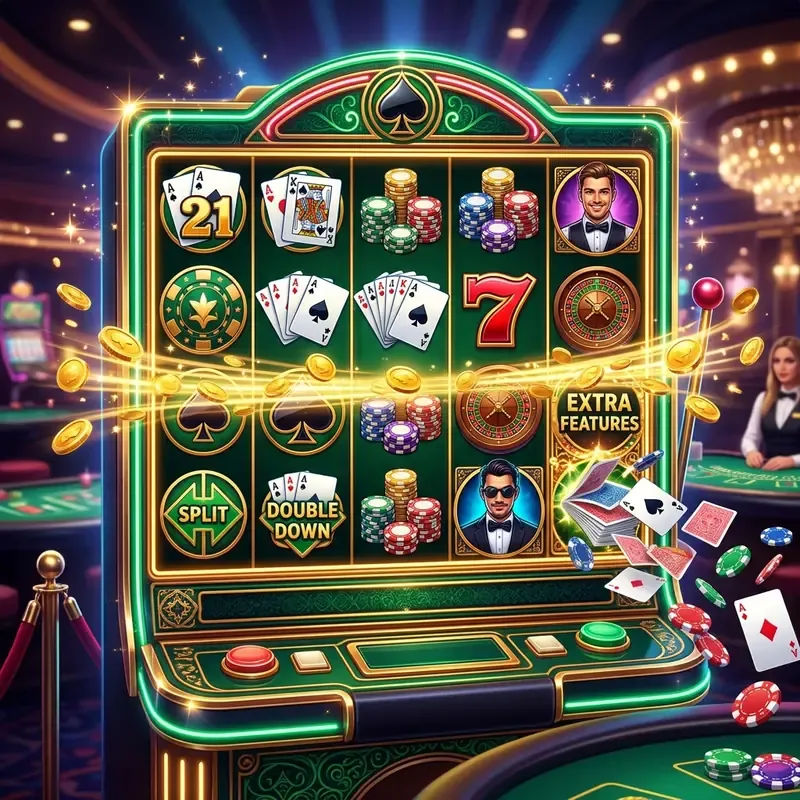
Classic, live and rule-based blackjack variants

FAQ

Can I play blackjack in Indian Rupees (INR)?

Yes. Many international online casinos accept INR deposits via UPI, NetBanking, Paytm, and cryptocurrency. Always confirm INR support before registering to avoid currency conversion fees. Some platforms also support popular e-wallets like PhonePe and Google Pay, though availability varies.

Is online blackjack legal in India?

India has no central federal law that specifically bans online casino games. However, individual states like Andhra Pradesh and Telangana have enacted restrictions. The legal landscape can shift, so always verify your state's current laws before playing for real money. This guide does not provide legal certainty for any jurisdiction.

Is live dealer blackjack rigged?

Live dealer games use physical cards dealt by a human, streamed in real time via HD video. The dealing process is visually verifiable, and reputable platforms are audited by third-party labs such as eCOGRA and iTech Labs. While no system is immune to theoretical risk, the visible dealing and independent auditing make rigging extremely difficult at licensed casinos. If you are still uncertain, look for platforms that publish their audit certificates publicly.

Do I have to pay taxes on blackjack winnings in India?

Under Section 115BB of the Indian Income Tax Act, winnings from gambling and betting are taxed at a flat rate of 30% (plus applicable cess). The casino or platform may deduct TDS (Tax Deducted at Source) before releasing your payout. Consult a tax professional for advice specific to your situation, as rules around reporting thresholds and deductions can be nuanced.

What is the best blackjack variant for beginners?

Classic blackjack with standard rules (3:2 payout, S17, 6 to 8 decks) offers the lowest house edge and the simplest decision framework. Avoid gamified variants like Lightning Blackjack until you are comfortable with basic strategy, as their modified payout structures require different optimal play.

How fast can I withdraw my blackjack winnings?

Payout speed varies by platform and payment method. UPI and e-wallet withdrawals from reputable Indian-facing casinos typically process within 1 to 24 hours. Bank transfers may take 2 to 5 business days. Always complete KYC verification (PAN card or Aadhaar) early to prevent withdrawal delays. If a platform consistently takes longer than the stated processing time, consider that a warning sign.

How do I set responsible gambling limits for blackjack?

Most licensed platforms let you set daily, weekly, or monthly deposit limits directly in your account settings. You can also set session time reminders and loss limits. If you feel your play is becoming difficult to control, use the self-exclusion option or contact a support service like the Responsible Gambling Council. Blackjack is paid entertainment, not a financial strategy. Set your budget before you sit down, and stop when you reach it.